

You are exhausted. Your body wants sleep. But the moment your head hits the pillow, your brain turns on.
For many people, this is one of the most frustrating patterns of poor sleep. They are tired during the day, looking forward to rest, and doing many of the “right” things at night. But when it is time to actually sleep, the mind becomes active, alert, restless, or emotionally charged.
This is the classic “tired but wired” pattern.
Sleep problems can come from many different sources. Sometimes poor sleep is related to sleep apnea, restless legs, pain, hormone changes, medication effects, alcohol use, blood sugar changes, or circadian rhythm disruption. In those cases, a sleep study, sleep specialist, medical workup, or targeted treatment may be the best next step.
But for many people, sleep disruption is closely connected to the nervous system.
The issue is not simply that the person needs to be more tired. The issue is that the brain and body are having trouble shifting out of stress, vigilance, mental overactivity, or emotional strain and into a state of rest.
This is where EXOMIND may be helpful.

Why Sleep Is Not Only a Nighttime Issue: The EXOMIND Perspective
We often think about sleep as something that begins when we get into bed. But the brain’s ability to sleep well is shaped by what is happening throughout the day.
When the nervous system is stuck in a pattern of stress, overthinking, emotional overload, anxiety, low mood, or burnout, the body may feel tired while the brain remains activated. This can make it harder to fall asleep, stay asleep, or wake feeling restored.
Common patterns include:
-
- Trouble “shutting the brain off” at night
-
- Racing thoughts or rumination
-
- Stress-related insomnia
-
- Waking up wired, restless, or emotionally activated
-
- Non-restorative sleep despite enough hours in bed
-
- Sleep disruption related to anxiety, depression, burnout, or emotional strain
For patients with this pattern, sleep is not just about the pillow, the mattress, the room temperature, or the bedtime routine. Those things matter, but they may not address the deeper issue: a nervous system that is having difficulty downshifting.
What EXOMIND Is — and What It Is Not
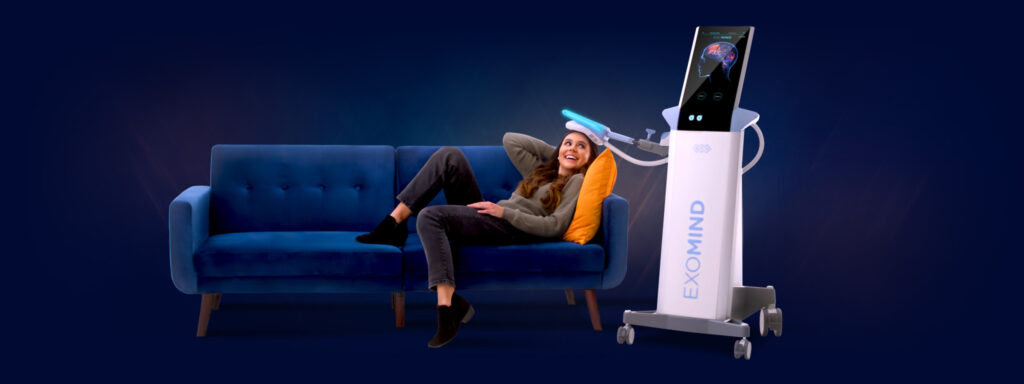
EXOMIND uses ExoTMS technology, a form of non-invasive brain stimulation related to transcranial magnetic stimulation, or TMS.
TMS has been studied for many years, especially in relation to depression, mood regulation, and brain-network function. BTL describes EXOMIND as an FDA-cleared treatment for depression that uses ExoTMS technology to stimulate areas of the brain involved in emotional regulation, cognitive function, and self-control. It is non-invasive, drug-free, and performed as a walk-in/walk-out procedure.
EXOMIND is not a sedative. It is not a sleeping pill. It is not a sleep-apnea treatment. It does not “knock you out” or force the body into sleep.
Instead, EXOMIND is designed to support brain regions involved in mood regulation, stress response, emotional control, cognitive function, and self-regulation. These are some of the same systems that can influence sleep quality when poor sleep is connected to stress, rumination, depression, anxiety, or nervous-system dysregulation.
In other words, EXOMIND should not be thought of as a simple “sleep treatment.”
It is better understood as a brain-based treatment that may help support the underlying regulation patterns that make healthy sleep possible.
Why Brain Regulation May Affect Sleep: How EXOMIND Targets Sleep
Good sleep requires more than fatigue. It requires a coordinated shift in the brain and nervous system.
The brain has to move away from alertness, vigilance, problem-solving, emotional processing, and repetitive thinking. It has to transition into a state where rest and recovery can happen.
When that transition does not happen smoothly, people may describe feeling:
-
- Physically tired but mentally awake
-
- Calm during the day but activated at night
-
- Unable to stop thinking once they lie down
-
- Emotionally sensitive or reactive in the evening
-
- Restless even when they have enough time to sleep
-
- Unrefreshed in the morning despite being in bed for enough hours
EXOMIND may help by supporting brain regions involved in:
-
- Calming overactive thought patterns
-
- Improving emotional regulation
-
- Reducing stress reactivity
-
- Supporting healthier mood patterns
-
- Helping the brain shift more effectively between alertness and rest
This is why EXOMIND may be most relevant for patients whose sleep problems are connected to the feeling of being “tired but wired.”
What the Research Suggests
A recent clinical study looked specifically at ExoTMS stimulation for adults with sleep disturbance. The study included 43 adults who received either active treatment or sham treatment. Participants received six sessions targeting the left dorsolateral prefrontal cortex, a region involved in mood, arousal, and self-regulation.
Sleep was measured using the Pittsburgh Sleep Quality Index, a widely used sleep-quality questionnaire.
In that study, the active-treatment group showed meaningful improvement in sleep quality at three-month follow-up. The active group improved by an average of 4.7 points on the Pittsburgh Sleep Quality Index. Nearly half achieved a clinically meaningful improvement, and more than half reached remission range on the sleep-quality measure. Among participants who had prolonged time to fall asleep at baseline, sleep onset improved by an average of about 46 minutes. The treatment was also reported as well tolerated.
This does not mean EXOMIND is guaranteed to resolve sleep problems. The study was relatively small, and the sleep outcomes were mostly based on patient-reported sleep quality rather than overnight sleep-lab testing. Larger studies are still needed.
However, the findings support the idea that ExoTMS may be a reasonable option for people whose sleep problems are connected to stress, mood, mental overactivity, or nervous-system dysregulation.
Broader research on repetitive transcranial magnetic stimulation, or rTMS, also supports the idea that magnetic brain stimulation may improve sleep quality in certain patients.
A 2026 systematic review and meta-analysis of randomized controlled trials found that rTMS significantly improved sleep quality in adults with insomnia disorder, including improvements in Pittsburgh Sleep Quality Index scores, Insomnia Severity Index scores, and sleep efficiency. The review included 19 studies, 23 trials, and 1,690 adults.
Another systematic review focused on patients with depressive mood and sleep-quality problems. It included 11 randomized controlled trials with 548 patients and found that rTMS improved sleep quality compared with control treatment. This is especially relevant because sleep issues often overlap with depression, anxiety, stress, and nervous-system dysregulation.
Who May Be a Good Fit?
EXOMIND may be worth considering when sleep problems are connected to:
-
- Chronic stress
-
- Burnout
-
- Difficulty winding down
-
- Mental overactivity at night
-
- Non-restorative sleep related to nervous-system dysregulation
-
- A desire to avoid or reduce reliance on sedative medications
The best fit is often the person who knows they are tired, wants to sleep, and may even have time to sleep — but whose brain cannot seem to settle.
For that person, the problem may not be a lack of effort. It may be a regulation issue.
When Another Sleep Approach May Be Better First
EXOMIND is not the first-line answer for every sleep concern.
Other evaluation or treatment may be more appropriate when there is concern for:
-
- Sleep apnea
-
- Loud snoring or gasping at night
-
- Restless legs
-
- Severe chronic insomnia without evaluation
-
- Significant pain disrupting sleep
-
- Medication or alcohol-related sleep disruption
-
- Shift-work or circadian rhythm disorder
-
- Complex psychiatric instability
-
- Medical conditions affecting sleep
In these cases, EXOMIND may still be considered as part of a broader plan, but it should not replace appropriate sleep evaluation.
For example, if someone is waking up gasping, snoring heavily, or experiencing significant daytime sleepiness, a sleep study may be the most important next step. If pain, hormones, blood sugar changes, medication side effects, or alcohol use are contributing, those factors should be addressed directly.
At Alpine Integrated Medicine, we do not believe every sleep problem should be forced into the same treatment pathway. The right approach depends on the person, the pattern, and the likely cause.
How to Think About the Investment
A six-treatment EXOMIND series is a meaningful investment. It is completely reasonable to compare that cost with other options, including a sleep specialist, sleep study, medication review, supplements, cognitive behavioral therapy for insomnia, or additional medical testing.
The important question is not simply whether other options exist.
They do.
The more useful question is: What kind of sleep problem are we trying to solve?
If the main issue is airway obstruction, restless legs, pain, medication effects, or another specific medical sleep disorder, a sleep-focused workup may be the best path.
If the issue is a brain and nervous-system pattern — stress, depression, anxiety, rumination, emotional strain, or the inability to downshift into rest — EXOMIND may offer a different kind of support than a traditional sleep intervention.
It is not a replacement for good medical thinking. It is one tool that may be helpful when the pattern fits.

FAQs
How long does it take to notice results from EXOMIND?
Many patients report improvements in sleep quality and mental clarity within 2-3 sessions, though individual responses vary. The most significant changes often appear after completing 4-6 sessions. Sleep onset may improve by an average of 46 minutes, according to recent clinical studies.
Who is the best candidate for EXOMIND?
EXOMIND works best for people who are tired, want to sleep, and have time to sleep—but whose brain cannot settle into rest due to stress, anxiety, racing thoughts, rumination, or emotional strain. It’s ideal for the “tired but wired” pattern. It is not the first choice for sleep problems caused by apnea, restless legs, pain, or medication side effects without addressing those root causes first.
Is EXOMIND a sedative or sleeping pill?
No. EXOMIND is not a sedative, sleeping pill, or sleep-apnea treatment. It is a non-invasive brain stimulation therapy designed to support emotional regulation, stress response, and cognitive control—systems that naturally influence sleep quality when nervous-system dysregulation is the underlying issue.
The Takeaway
EXOMIND should not be viewed as a simple sleep treatment.
It is better understood as a non-invasive, brain-based therapy that may help improve the underlying regulation of mood, stress, arousal, and mental overactivity. For the right patient, those changes may translate into better sleep quality, easier sleep onset, and more restorative rest.
At Alpine Integrated Medicine, our goal is to match the treatment to the patient.
Sometimes the right next step is a sleep study. Sometimes it is hormone work, medication review, blood sugar support, cognitive behavioral therapy for insomnia, supplements, nervous-system care, or a more complete medical evaluation.
And sometimes, when sleep issues appear connected to brain-based patterns of stress, mood, rumination, and overactivation, EXOMIND may be a meaningful part of a larger plan to improve sleep and overall well-being.
Sources
-
- BTL. “EXOMIND.” Official EXOMIND product page.
-
- Brodie, R., et al. “Effects of ExoTMS stimulation on sleep quality: a sham-controlled study.” Sleep Science and Practice, 2026.
-
- Cao, Z., et al. “Efficacy of repetitive transcranial magnetic stimulation for insomnia disorder: a systematic review and meta-analysis of randomized controlled trials.” Frontiers in Neuroscience, 2026.
-
- Li, Y., et al. “The effect of repetitive transcranial magnetic stimulation therapy on sleep quality in patients with more than mild depressive mood: a systematic review and meta-analysis.” Frontiers in Psychiatry, 2025.